
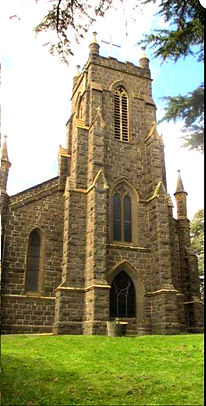
St Paul's Kyneton
St Paul’s Anglican Church, located in Kyneton, Victoria, stands as one of the state's oldest and most architecturally significant ecclesiastical structures. Previously known as the Church of England, this striking Early English Gothic building has served as a spiritual and community anchor for the region since the mid-19th century, reflecting the rapid growth and development of rural Victoria during and after the gold rush era.
Before a dedicated church building existed, the local Anglican congregation gathered for worship in temporary locations, primarily using the Alms House on Ebden Street. As Kyneton's population grew, the need for a permanent, substantial place of worship became clear and local architect William Douglas was commissioned to design the new building. The foundation stone was officially laid on December 28, 1855, by the Right Reverend Charles Perry, the first Bishop of Melbourne and it opened its doors for services on November 30, 1856. The structure was completed in 1860, utilizing distinctive local bluestone salvaged from disused police stables. The building was formally consecrated on December 3, 1862.
Situated prominently at the intersection of Powlett and Yaldwyn Streets, it forms a visual anchor for the historic townscape of Kyneton. Architecturally, the church is a textbook example of the Early English Gothic style, featuring a steeply pitched roof, lancet windows, and heavy bluestone masonry.
Between 1927 and 1928, a prominent western bell tower was constructed to commemorate a major milestone in the church's anniversary. Designed by the architectural firm Gawler & Drummond, the tower was dedicated in February 1928 and substantially altered the building's silhouette, giving it the landmark appearance it retains today.
Inside, the church houses a treasure of international musical heritage: a rare pipe organ built in 1854 by the renowned craftsman John Smith of Bristol, England. The organ was originally imported to Australia for use in the first St Paul's Cathedral in Melbourne. In 1889, it was purchased and relocated to Kyneton, where it continues to be celebrated for its historical integrity and unique sound.
Today, St Paul’s remains a vibrant, active place of worship. It operates as a core component of the Central Highlands Anglicans parish, which also serves the neighbouring communities of Malmsbury and Trentham, preserving both its religious mission and its rich colonial history for future generations.


St John's Malmsbury
St John's Anglican Church in Malmsbury, Victoria—originally known as the Church of England—was established during the gold rush era. Its foundation stone was laid in 1861, and the bluestone building was officially opened in 1866.
The church's history reflects the growth and changing dynamics of the region's pioneering and mining communities:
•Early Beginnings: The first Church of England services in Malmsbury were held in Mr. French's local store by the Reverend James Sullivan, who travelled from nearby Kyneton. As the gold rush boomed, a small school was used for services in 1857, but the congregation quickly outgrew it.
•Construction & Architecture: In November 1861, Bishop Charles Perry laid the foundation stone for the permanent church, with an audience of about 300 people. The structure was built using local bluestone—a defining feature of Malmsbury’s historic buildings. The church ultimately cost £3,751, with the local community proudly contributing half of the funds.
•Official Opening: The church was officially opened on January 28, 1866, by Bishop Perry.
•Modern Heritage & Affiliation: Today, St John the Evangelist Church is classified as a significant heritage site in Victoria. The church remains active as part of the Central Highlands Anglican Parish (alongside Kyneton and Trentham) under the Anglican Diocese of Bendigo.

St George's Trentham
St George's Anglican Church in Trentham, Victoria, Australia has served as a centre for the local Anglican community since its first services in 1864. From 1890 the town and the congregation grew and the Church looked after 6 other district churches. It had a growing Sunday School and over 150 people attended the evening service. John Wolff, Guardian and Treasurer, asked that St George’s be put under the direction of the Archdeacon of Sandhurst (Bendigo) because the vicar of Kyneton would not allow St George’s to hold more services!
Key Historical Milestones
-
1864: The town was surveyed and the very first Anglican church service was held in Trentham as part of the Parish of Kyneton.
-
1882: A wooden church building, rectory and hall were erected on a site fronting Albert Street to accommodate the growing congregation.
-
1927: A foundation stone for a brand new brick building was laid on May 14 by local pastoralist Arnold Caddy. This structure, designed by architect J.H. Eales, replaced the original timber church.
-
1927–1928: A stunning "Light of the World" stained-glass window was ordered from Brooks, Robinson & Co. and installed above the eastern altar.
-
1983: The land around the church was given to the Trentham Bush Nursing hospital and five units for elderly residents were built.
-
2024: After 160 year,s St Georges again became part of the Parish of Kyneton separating from Woodend.
-
Present Day: The church continues to operate as an active place of worship and is part of the Parish of Kyneton-Malmsbury-Trentham within the Diocese of Bendigo.
The church is well-known for its distinctive architectural features, including its truncated corners, tuck-pointed red-ochre bricks, and pointed arch stained-glass windows, making it a unique architectural feature of the town.
other history
...